
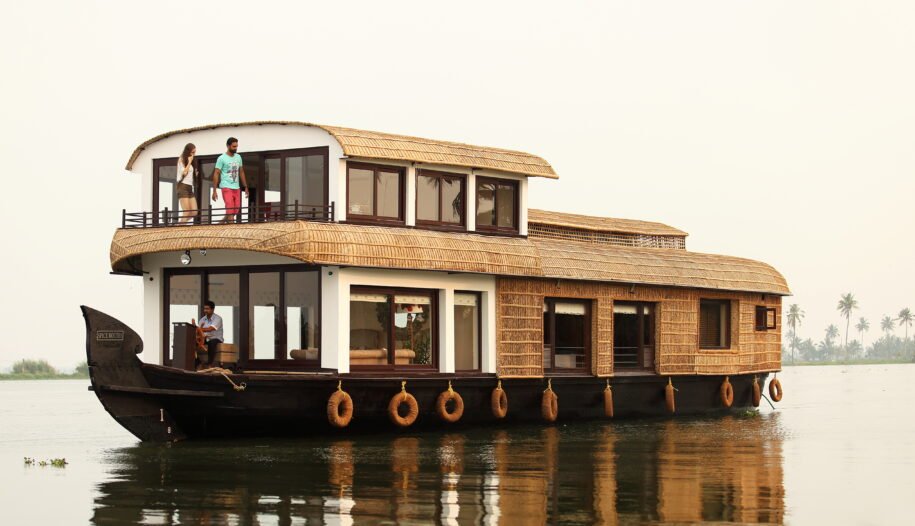
Cruise through Alappuzha long enough and you’ll pass right through Kuttanad without anyone on board mentioning what’s underneath the boat. It’s the only place in India where farmers grow rice below sea level, and one of just a few spots anywhere in the world where that’s even possible.
Land Farmers Built With Their Hands
The fields here sit somewhere between 1.2 and 3 meters under sea level, the lowest altitude anywhere in the country. Farmers didn’t inherit that land ready-made. Over 150-odd years, they piled up mud dikes by hand, pushing back lake and river water bit by bit until pockets of dry-ish ground, padasekharams, emerged where rice could actually grow. No bulldozers, no engineering firms, just generations of people who kept rebuilding whatever the water knocked down the year before.
The practice took off sometime around the 1870s and kept expanding into the early 1900s. What’s left today falls into three rough types. Karapadam covers the upland stretches, close to 16,000 hectares across hundreds of separate plots. Kayal padam sits lower still, reclaimed straight from the lakebed, one to two meters under sea level. Then there’s kari padam, with soil so dark it looks almost like coal, found around areas like Purakkad. Four rivers feed the whole system, the Pamba, Meenachil, Achankovil, and Manimala, all winding through before eventually spilling into the Arabian Sea.
A Farming Tradition the World Eventually Noticed
The Food and Agriculture Organization named the Kuttanad Farming System a Globally Important Agricultural Heritage Site in 2013. It’s a short list, and Kuttanad earned its spot for how the whole system works, not just what it produces.
The method itself is a bit of a balancing act. A network of canals and pumps lets farmers adjust water levels through the year, and they’ve learned to work with the seasons rather than fight them. Monsoon rains bring freshwater down from the hills and flush the fields out. By summer, salt water creeps back in from the coast, and farmers shift their entire approach to match. The tides run this place as much as any calendar does.
Water as the Only Road That Matters
More than 1.8 million people live here, most working the fields, and a lot of them travel by canoe because there’s simply no road to take instead. Canals carry people between homes, small shops, schools, temples, anywhere they need to go. Dry ground is genuinely the exception in Kuttanad, not the rule.
What You’re Looking at From the Deck
Once you know all this, the view from a houseboat changes a bit. Those calm paddy fields drifting past are technically sitting below the water level around them, propped up by dikes someone has to maintain constantly. People still paddle the same canals your boat is cruising through, running errands, heading home, going about an ordinary day. Few places let a tourist cruise and a working, centuries-old landscape share the exact same water like this.
Cruise It With a Crew Who Knows the Difference
Kuttanad rewards a slower pace, and it helps to have a crew that actually points out what’s happening beyond the scenery. Spice Routes Luxury Cruise, certified under Kerala Tourism’s Diamond Classification for safety, sustainability, and service, takes its houseboats through these quieter stretches, giving guests a real look at farming that exists nowhere else in India.
More at spiceroutes.in.
Leave a Reply