
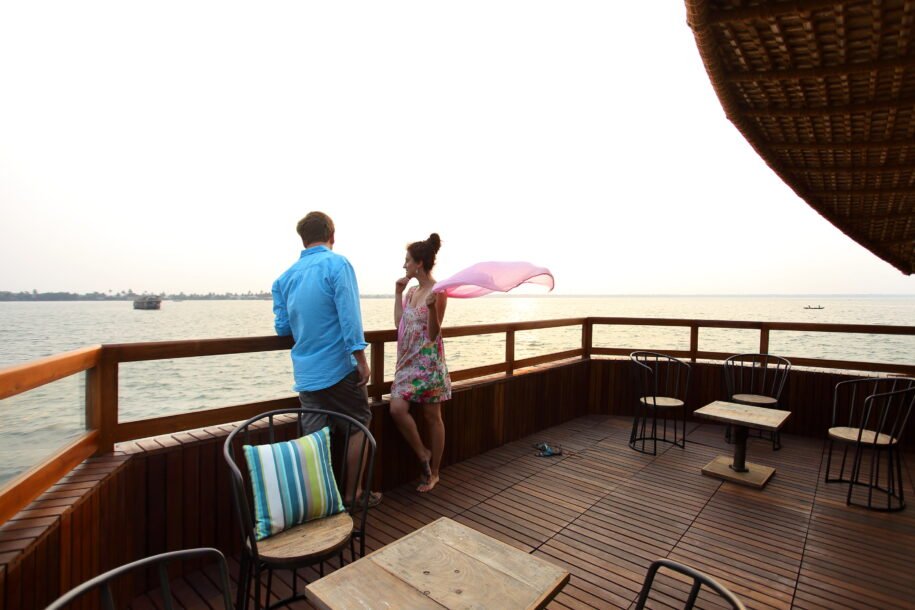
Every Alappuzha brochure shows the same shot. Green fields, coconut trees, a houseboat catching the afternoon light, maybe a fisherman silhouetted against a sunset for good measure. Nobody puts the night on the cover, which is a shame, because that’s usually the part people end up talking about once they’re actually home and someone asks how the trip went.
Once the Canals Empty Out
Daytime on the backwaters has its own rhythm. Boats passing each other on narrow stretches, villagers running errands along the banks, birds working the treeline for whatever they’re after. Come evening, most of that traffic winds down on its own, without anyone deciding it should. The canals go quiet in a way that’s genuinely hard to describe until you’ve sat through it yourself, water against the hull, some insect calling from the palms, maybe a bird somewhere you can’t quite place in the dark. That’s about the whole soundtrack. For a destination that’s basically built around slowing down, this is where the entire idea finally catches up with you and actually sinks in.
There’s a shift in scale too, one that’s easy to miss until it happens. During the day, the backwaters feel wide open, a lake stretching out, a canal disappearing around a bend, always somewhere else to look. At night the same water shrinks down to whatever the boat’s small lights touch, and everything past that edge just disappears into dark. It’s a strange kind of privacy for a place that’s normally so open.
A Sky With Nothing in the Way
Alappuzha sits far enough from the usual city glow that a clear night actually looks clear, which sounds obvious until you’ve spent your whole life somewhere it isn’t true. Stars that stay hidden over Kochi or any of Kerala’s brighter towns show up here without much effort at all, and the water underneath, when it’s still enough, holds a faint reflection of the same sky, doubling whatever’s overhead. Nothing about it is staged. No telescope required, no app pointing out constellations, no guide narrating unless someone specifically asks. Just an open deck and a sky doing what skies do naturally when nothing artificial is getting in the way.
Timing helps, admittedly. A moonless night in the drier months, roughly October through February, tends to give the darkest, clearest views, though even a partial moon over still water has its own quiet appeal, silvering the canal instead of blacking it out entirely. Either way, it’s not something that needs planning around too carefully. Most nights out here beat most nights almost anywhere else people are used to.
What Actually Happens After Dinner
Most houseboats settle into an anchorage for the night once dinner wraps up, usually somewhere quieter than the daytime route, tucked away from other boats and whatever noise tends to come with them. After that, there’s not much of a plan, and that’s sort of the point. Some people talk on deck for a while. Some read with a lamp on, moths circling the light within minutes. A fair number just sit there and let the day settle, which sounds like nothing much until it’s actually happening to you and an hour’s gone by without anyone noticing.
Ask around and this stretch of the evening tends to be the part people bring up first when they’re describing the trip afterward, more than the temples or the paddy fields even. Mostly because nothing about it asks anything of you. No itinerary, no next stop, no photo to line up before the light changes. Just the boat rocking slightly at anchor and whatever conversation or silence fills the gap.
Why the Dark Half Matters Just as Much
The daytime cruise sells the postcard, and fair enough, it earns that reputation honestly. But the night gives you something daylight simply can’t manage, real stillness, the kind that doesn’t come with a schedule attached or a next activity waiting. In a place where the entire appeal is supposedly about slowing down, an hour on deck watching stars might be the one part of the whole trip that actually delivers on that promise in full, rather than just gesturing toward it.
And there’s something to be said for the morning after, too. Waking up on water that was pitch dark and silent the night before, watching mist lift off the canal as the first boats start moving again, feels like a small reward for having sat through the quiet part first.
Spend the Night, Not Just the Afternoon
None of this happens on a day cruise. It needs an actual overnight stay, and it needs an operator who picks the anchorage with some care instead of just stopping wherever happens to be convenient at the time. Spice Routes Luxury Cruise anchors its houseboats in quieter stretches of the backwaters for exactly this reason, backed by Kerala Tourism’s Diamond Classification for safety and guest comfort. If the plan is to see Alappuzha properly, day and night both, the overnight leg isn’t optional, it’s really the whole point. Book one at spiceroutes.in.
Leave a Reply