
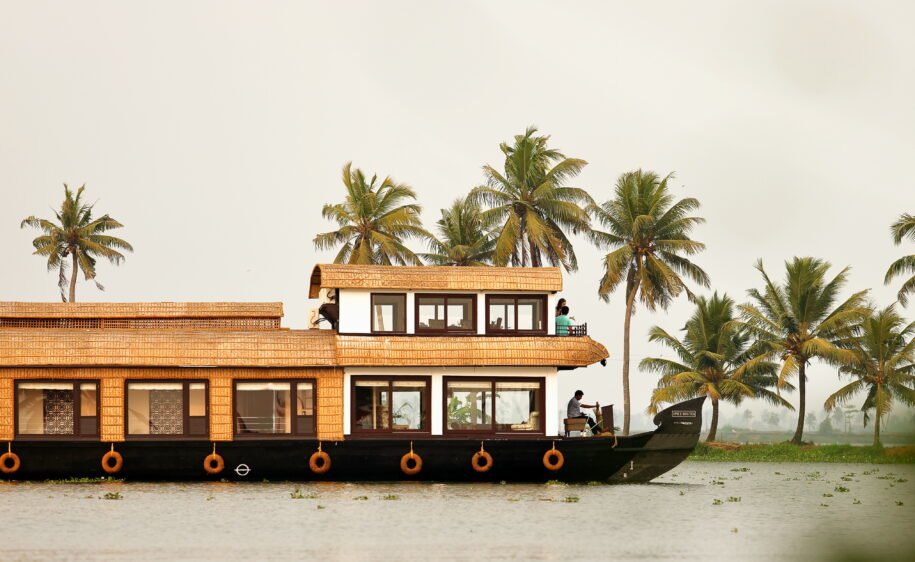
A houseboat moves slowly enough that you notice things a car would blow past. A spire here, a temple gopuram there, half hidden behind coconut trees, showing up every few kilometers along the same water everyone comes for the scenery. Most of what’s tucked into these villages has been standing since long before anyone thought to put “backwater tourism” on a brochure.
A Church That’s Older Than Most Countries
St. Mary’s Forane Church sits on the banks of the Pamba River. Locals call it Champakulam Church, and tradition holds it as one of seven churches St. Thomas the Apostle founded after landing in Kerala, which would put its age somewhere near 1,600 years. It still functions as the mother church for almost every Catholic Syrian church in Alleppey. Walk around the building and that history shows itself plainly, Syrian design choices sitting next to Portuguese ones, added on by different generations who apparently preferred building onto the old rather than starting fresh.
There’s also a connection to the old Chempakassery kingdom, whose rulers based themselves near what’s now the Ambalapuzha temple, and the church had a real hand in Kerala’s ecumenical movements back in the 1700s. Once a year it runs the Feast of Mother Mary, eleven days long, wrapping up close to mid-October, and people still turn out for it in the thousands. Champakulam has its own boat race too, run jointly with the Ambalapuzha temple to mark a procession that goes back centuries. By tradition, the church supplies rope and bamboo for the race. Small detail, but it ties this old building straight back to the water it’s been sitting beside for sixteen centuries.
A Temple Still Feeding Whoever Shows Up
A short way off, Ambalapuzha Sree Krishna Temple has drawn people in for generations, built in the classic Kerala style, its walls painted with the ten avatars of Vishnu. What actually sticks with visitors, though, is the palpayasam. Sweet rice pudding, made and served daily, offered to anyone who walks in, a practice the temple has kept up for centuries without turning it into a performance for tourists. It’s simply what the place has always done. The royal lineage tied to Champakulam Church runs through here as well, two entirely different faiths sharing one royal history, and in some years, one boat race.
Further Along the Water
Push further down the backwaters and Arthunkal St. Sebastian’s Church comes into view, pulling pilgrims from outside Kerala every January for its feast. People come for healings they credit the site with, and worshippers arrive across religious lines, not just from the Christian community. Inland a bit, Mannarasala Temple keeps its own tradition running, built around a serpent deity and led by a line of priestesses, something you won’t come across at most Kerala temples. Chettikulangara Bhagavathy Temple carries its own reputation for granting wishes, and further in still, St. George Forane Church at Edathua has its own long history as a pilgrimage stop.
Not Scenery, a Lived-In Landscape
What separates this stretch of backwater from a standard tourist route is how naturally these sites fold into ordinary village life. A houseboat gliding past one isn’t cruising through decoration. It’s moving past a building where people still gather for feasts, festivals, and daily prayer, doing exactly what their grandparents did, long before anyone thought to sell the view.
A Cruise Route That Takes This Seriously
Most cruises stick to the wider, more scenic stretches and leave these smaller village channels alone. Spice Routes Luxury Cruise doesn’t skip them, weaving its houseboats through the same waters that pass Champakulam, Ambalapuzha, and the smaller shrines further along, so guests see these places as part of the backwaters rather than as an afterthought. Backed by Kerala Tourism’s Diamond Classification for safety, sustainability, and guest experience, it’s the kind of cruise where the history gets as much attention as the scenery. Plan one at spiceroutes.in.
Leave a Reply